
Every four years, the football world fixates on the same names. Brazil. France. Argentina. Spain. And every four years, at least one nation nobody saw coming tears up the script and sends those predictions straight into the bin.
The 2026 FIFA World Cup is the most unpredictable edition in history. With 48 teams competing across the USA, Canada, and Mexico, a new Round of 32, and a global talent gap that has narrowed dramatically, the conditions for shock results have never been more favorable. Smaller nations now use elite sports science. Their players compete weekly in the Champions League, the Premier League, and Serie A.
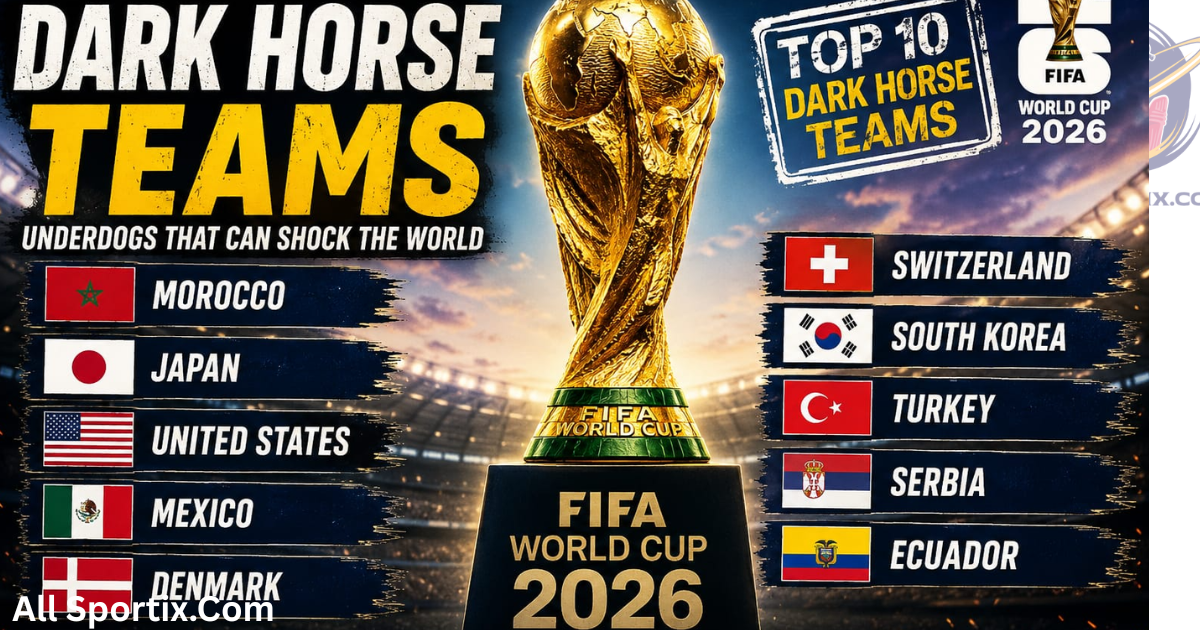
So who are the FIFA World Cup 2026 dark horse teams capable of destroying a giant this summer? Here is a full breakdown built on squad analysis, group draws, recent form, and tactical identity of the ten sides most likely to cause the biggest upsets.
What Is a Dark Horse Team in FIFA World Cup 2026?
A dark horse team is a nation that arrives at the tournament without being considered a genuine title favorite but possesses the quality, tactical structure, and draw luck to advance deep into the knockout stage and potentially shock one of the sport’s established powerhouses along the way.
At World Cup 2026, a credible dark horse must meet several criteria:
- Recent giant-killing pedigree : Results against top-ten ranked nations in competitive matches
- A favorable or manageable group stage draw : A realistic path to the Round of 32
- Elite club talent : Players performing at the highest club level regularly
- Tactical clarity : A defined system that is difficult to prepare for in short tournament turnarounds
- Mental resilience : Experience of performing under major tournament pressure
The expanded 48-team format is a game-changer for underdog teams. The eight best third-placed teams now advance alongside group winners and runners-up, meaning a side doesn’t even need to win its group to reach the knockout stage. That extra lifeline changes everything.Players who have most goals in international football history show their talent in this mega league.
How We Selected the Best Dark Horse Teams for World Cup 2026
This list is not based on bookmaker odds alone. To identify the most credible World Cup 2026 sleeper teams, we evaluated each nation across four key pillars:
- Squad depth and European club presence :How many players feature regularly at elite clubs?
- Recent competitive results : Form against top-20 ranked nations in the past 18 months
- Group stage draw : Which path offers the most realistic route to the knockout rounds?
- Tactical identity : Does the team have a clear system that translates under tournament conditions?
The result is a list of ten teams that, taken together, represent the most compelling case for World Cup 2026 surprise runs.Experts also predict top 10 favourites to win FIFA world cup 2026.
Top 10 Dark Horse Teams for FIFA World Cup 2026
1. Morocco
Morocco have reached a point where calling them a dark horse almost feels like an insult. They became the first African and Arab nation to reach a World Cup semi-final at Qatar 2022, eliminating Belgium, Spain, and Portugal in the process. That run was not built on luck it was built on one of the most defensively disciplined tactical systems in international football.
Achraf Hakimi (PSG), Yassine Bounou in goal, and a squad packed with Champions League-level talent give Morocco elite quality throughout. Their approach organized, compact, lethal on the counter is precisely the kind of system that causes favorites problems in tight knockout matches.
Placed in Group C alongside Brazil, Scotland, and Haiti, Morocco are realistic group winners. If they advance and they should a deep run to the quarter-finals or beyond is very much on the table.
Key Player: Achraf Hakimi (PSG) Group: C Brazil, Morocco, Scotland, Haiti Realistic ceiling: Semi-finals
2. Japan
Japan is probably the most complete dark horse at the 2026 World Cup. They have elite club players scattered across Europe’s top leagues, a clear tactical identity that is difficult to disrupt, and a recent tournament pedigree that demands respect.
Knocking out Germany and Spain in the group stage at Qatar 2022 was not a joke it was the product of a high-press system executed with frightening precision. In 2026, that squad is younger, faster, and better prepared. Kaoru Mitoma and Takefusa Kubo provide attacking spark, while Wataru Endo anchors the midfield base.
Group F features the Netherlands as the frontrunner, but Japan have already proven they beat European heavyweights. They recently demonstrated their abilities by shocking England in a friendly match, and in contrast to other dark horses, Japan is not afraid to attack and has consistently exceeded expectations on the biggest stage of football.
Key Player: Kaoru Mitoma (Brighton) Group: F Netherlands, Japan, Tunisia, Sweden Realistic ceiling: Quarter-finals
3. United States
The host nation factor is real and it is powerful. Playing in front of passionate home crowds across multiple venues, with familiar conditions and no long-haul travel demands, gives the United States a structural advantage that goes beyond squad talent.
The US team enters 2026 with its most talented generation ever. This squad is no longer MLS-centric Pulisic, Adams, McKennie, Weah, Reyna, Musah, and Balogun all bring European experience, intensity, and confidence. Head coach Mauricio Pochettino has built a young, energetic side with genuine belief. Home World Cups do strange things to teams the crowd lifts performance, the pressure sharpens focus, and the moments that matter are played in front of 80,000 roaring home supporters.
Group D features Australia, Paraguay, and Türkiye all tough opponents but a team performing in their own backyard, with this generation of European-based talent, is not one any Round of 32 opponent will welcome.
Key Player: Christian Pulisic (AC Milan) Group: D USA, Australia, Paraguay, Türkiye Realistic ceiling: Quarter-finals
4. Mexico
Mexico arrive at a home World Cup carrying the emotional weight of a nation and the tactical intelligence of one of CONCACAF’s most experienced programs. Opening the entire tournament against South Africa at the iconic Estadio Azteca, in front of their own fans, sets the psychological tone immediately.
For Mexico, opening a home World Cup 2026 is an emotional accelerator and a psychological threat in equal measure. Altitude, crowds and tradition promise energy, and Mexico’s World Cup 2026 group projections hinge on whether they can dominate territory early, build emotional momentum.FIFA world cup 2026 match schdule and fixtures are displayed.
Group A also features South Korea, South Africa, and Czechia a genuinely winnable group. If Mexico top their group and ride the home crowd into the knockout stages, the momentum of a nation behind them could carry them further than their FIFA ranking suggests.
Key Player: Santiago Giménez Group: A Mexico, South Korea, South Africa, Czechia Realistic ceiling: Quarter-finals
5. Denmark
Denmark did not qualify for World Cup 2026, losing their playoff spot in dramatic fashion when Scotland scored twice in stoppage time to deny them. It remains one of the most heartbreaking qualification exits in recent memory. Their absence is a genuine loss for the tournament, because on paper this was a squad fully capable of a dark horse run.
With Christian Eriksen’s creativity, Rasmus Højlund’s finishing, and Pierre-Emile Højbjerg’s midfield engine, Denmark had the quality to trouble any team in the bracket. Their set-piece delivery and physical midfield control make them awkward opponents for technically superior teams, particularly in knockout matches decided by fine margins. Denmark’s story in 2026 is ultimately one of what might have been but their talent level earns a place on any list of teams the tournament will miss.
Key Player (if qualified): Christian Eriksen Reason for omission: Failed to qualify via UEFA playoffs
6. Switzerland
Switzerland are one of football’s most underrated consistent performers. Switzerland’s style of play is about being organised, defensive, and pressing they can also win games with quick transitions. This is a side that few favorites would want to face in the knockout stages.
They were tied with Spain for second-fewest goals allowed during qualifying, with England being the lone team with a better defensive record. That defensive prowess will be Switzerland’s calling card at the 2026 FIFA World Cup. They’re coming off three straight finishes in the Round of 16 but maybe 2026 will be the year they take it one step further. They already reached the quarter-finals of Euro 2024, losing to England in a penalty shootout.
Group B, featuring Canada, Qatar, and Bosnia & Herzegovina, is navigable. Switzerland are experts at surviving into the knockout rounds the question is whether they can finally win a high-stakes match when it matters most.
Key Player: Granit Xhaka (Bayer Leverkusen) Group: B Canada, Switzerland, Qatar, Bosnia & Herzegovina Realistic ceiling: Quarter-finals
7. South Korea
South Korea has a habit of showing up when it matters. The team led by Son Heung-min uses a combination of disciplined players who run fast and work hard. They maintained an unbeaten record during their qualifying campaign. They may not dominate possession but they know how to win big moments. And in knockout football, that’s everything.
South Korea arrive as professional disruptors and potential World Cup dark horse candidates. Their pressing structure is among the most synchronized in international football, forcing chaotic buildup and rushed circulation. They don’t require dominance to control a World Cup match they require mistakes.
Son Heung-min’s individual quality can unlock any defense on his day, and their group alongside Mexico, South Africa, and Czechia gives them a genuine path to the Round of 32.
Key Player: Son Heung-min (Tottenham Hotspur) Group: A Mexico, South Korea, South Africa, Czechia Realistic ceiling: Round of 16
8. Turkey
Turkey often flies under the radar but that’s exactly what makes them dangerous. With a new generation blending young European-based talent and experienced players, Turkey has quietly built a balanced squad. Historically unpredictable as they’ve shown at the 2008 Euros and 2002 World Cup they can rise when expectations are low.
Turkey reached the quarter-finals of Euro 2024 with a mix of young, technical players and veteran stars. Although they don’t enter the 2026 draw among the top seeds, they have previously shown they can beat top-ten ranked nations in big matches.
Placed in Group D alongside the USA, Australia, and Paraguay, Türkiye have a credible shot at advancing. Their combination of experienced European-based players and hungry young talent makes them a tricky, unpredictable opponent for anyone they meet in the knockout bracket.
Key Player: Hakan Çalhanoğlu (Inter Milan) Group: D USA, Australia, Paraguay, Türkiye Realistic ceiling: Round of 16
9. Serbia
Serbia did not qualify for World Cup 2026. Despite assembling one of their most talented squads in decades, they failed to secure a place in North America. That talent level, however, demands recognition.
Serbia arrive as genuine dark horses in talent terms the Vlahović-Mitrović double-act is one of the most physically imposing strike partnerships in European football, and Milinkovic-Savić’s control of midfield games is something top-four nations envy. Their record 29 qualifying goals the most of any UEFA team in their group only makes their absence more baffling and more painful.
For a team with this quality to miss out speaks to the brutal randomness of knockout qualification. They remain a side to watch in future cycles, and their absence makes the 2026 tournament genuinely poorer.
Key Player (if qualified): Dušan Vlahović (Juventus) Reason for omission: Failed UEFA qualifying
10. Ecuador
Ecuador have not lost a single competitive match since September 2024. That unbeaten streak is not a minor footnote it is a statement about a team in the form of their lives, built on a defensive structure that rivals any in South America.
Piero Hincapié (Arsenal) and Willian Pacho (PSG) form a centre-back partnership that is physically imposing and positionally elite. Moisés Caicedo (Chelsea) dominates midfield battles. And Kendry Páez, the teenage Chelsea wonderkid, provides the creative spark that gives Ecuador a dimension beyond pure defensive grit.
Ecuador arrives at the tournament as a dark horse with enviable defensive solidity and an undefeated streak since 2024, consolidating itself as a truly dangerous rival. Group E features Germany, Ivory Coast, and Curaçao and Ecuador’s structure is built precisely to frustrate giants.
Key Player: Moisés Caicedo (Chelsea) Group: E Germany, Ecuador, Ivory Coast, Curaçao Realistic ceiling: Round of 16
Which Dark Horse Team Has the Best Chance to Reach the Semi-Finals?
Based on squad quality, draw, and recent form, Morocco holds the strongest case. Their 2022 semi-final run established a blueprint, their squad has matured with more European experience, and Group C while featuring Brazil also includes winnable matches against Scotland and Haiti.
Japan are the second most credible pick. Their tactical discipline and giant-killing record at Qatar 2022 earns them genuine respect, and a favorable bracket path beyond the Round of 32 could see them mirror their South Korean neighbors’ famous 2002 run.
USA cannot be overlooked simply because of the home crowd factor. History is full of host nations outperforming every expectation and this American squad is more talented than any previous generation.
Dark Horse Teams vs Tournament Favorites
| Team | Category | Group | Key Player | Odds to Win |
|---|---|---|---|---|
| Morocco | Dark Horse | C | Achraf Hakimi | +8000 |
| Japan | Dark Horse | F | Kaoru Mitoma | +5000 |
| USA | Dark Horse / Host | D | Christian Pulisic | — |
| Mexico | Dark Horse / Host | A | S. Giménez | — |
| Switzerland | Dark Horse | B | Granit Xhaka | — |
| South Korea | Dark Horse | A | Son Heung-min | — |
| Türkiye | Dark Horse | D | Hakan Çalhanoğlu | — |
| Ecuador | Dark Horse | E | Moisés Caicedo | — |
| France | Favorite | I | Kylian Mbappé | +450 |
| Spain | Favorite | H | Pedri | +500 |
| Argentina | Favorite | J | Lionel Messi | +550 |
Key Players Who Could Drive These Underdogs to Success
Individual moments of brilliance routinely define World Cup dark horse runs. These are the players most likely to be the catalyst:
- Achraf Hakimi (Morocco) : PSG’s right-back who combines defensive solidity with explosive attacking runs. Can decide a knockout match in one moment.
- Kaoru Mitoma (Japan): One of the Premier League’s most direct, unpredictable wide players. Creates chances from nothing.
- Christian Pulisic (USA): AC Milan’s star carries the emotional and technical weight of a host nation’s dreams.
- Moisés Caicedo (Ecuador): Chelsea’s midfield engine offers both defensive cover and forward-driving quality in equal measure.
- Son Heung-min (South Korea): A player who has delivered in the biggest club matches; now hunting the same in a World Cup knockout.
- Hakan Çalhanoğlu (Türkiye) : Inter Milan’s deep-lying playmaker dictates pace and controls space. Exactly the type knockout opponents struggle to neutralize.
Predictions: Can a Dark Horse Team Win FIFA World Cup 2026?
History says yes eventually. But realistically, the structural advantages still favor the established elite. France, Spain, and Argentina have squad depth that most dark horses cannot match across seven matches in 39 days.
What the expanded 48-team format does, however, is extend every team’s potential journey. A dark horse that peaks in the Round of 32 now has more matches to build momentum. And in knockout football, momentum is everything.
The most realistic outcome is a dark horse reaching the semi-finals Morocco in 2022 proved it is possible without winning the tournament. Japan in 2026 or Morocco going one step further are the two most credible scenarios for a historic result.
Final Thoughts on FIFA World Cup 2026 Dark Horse Teams
The beauty of football is that scripts get torn up. Every World Cup delivers at least one story nobody predicted a team that entered quietly, won matches nobody expected them to win, and left with a nation’s pride permanently elevated.
Morocco and Japan are the two FIFA World Cup 2026 dark horse teams best placed to deliver that story in North America. But Switzerland’s defensive organization, Ecuador’s unbeaten form, and the USA’s home advantage all make for compelling alternative narratives.
FAQs About FIFA World Cup 2026 Dark Horse Teams
Which team is the number one dark horse at World Cup 2026?
Morocco are the top dark horse pick — they have the squad, the tactical system, and the tournament experience to reach the semi-finals again.
Can Japan repeat their Qatar 2022 giant-killing performances in 2026?
Yes — Japan’s squad is younger and more experienced in European football than in 2022, making another major upset very realistic.
Why is the USA considered a dark horse at home?
Host nations historically outperform expectations due to crowd support, no travel pressure, and the psychological boost of playing in their own country.
Is Switzerland a genuine dark horse or just a consistent group-stage team?
Switzerland have reached the Round of 16 three consecutive times and the Euro 2024 quarter-finals — in 2026, with a favorable group, they have genuine potential to go further.
Did Denmark and Serbia qualify for World Cup 2026?
No — both Denmark and Serbia failed to qualify. Denmark lost their playoff spot on dramatic late goals, while Serbia also missed out despite assembling one of their most talented squads.
Why is Ecuador on this dark horse list?
Ecuador are unbeaten since September 2024, have Premier League and Ligue 1 stars in their squad, and enter the tournament with strong defensive structure and recent South American qualifying experience.
Can Mexico go deep at a home World Cup in 2026?
Mexico have a very favorable group draw and the home crowd advantage. Emotional momentum from playing in front of their own fans at the Azteca could push them deep into the knockout bracket.
What makes Türkiye a sleeper team at World Cup 2026?
Türkiye reached the Euro 2024 quarter-finals with young, technical talent and historically perform best when expectations are low — exactly the conditions they face in 2026.