
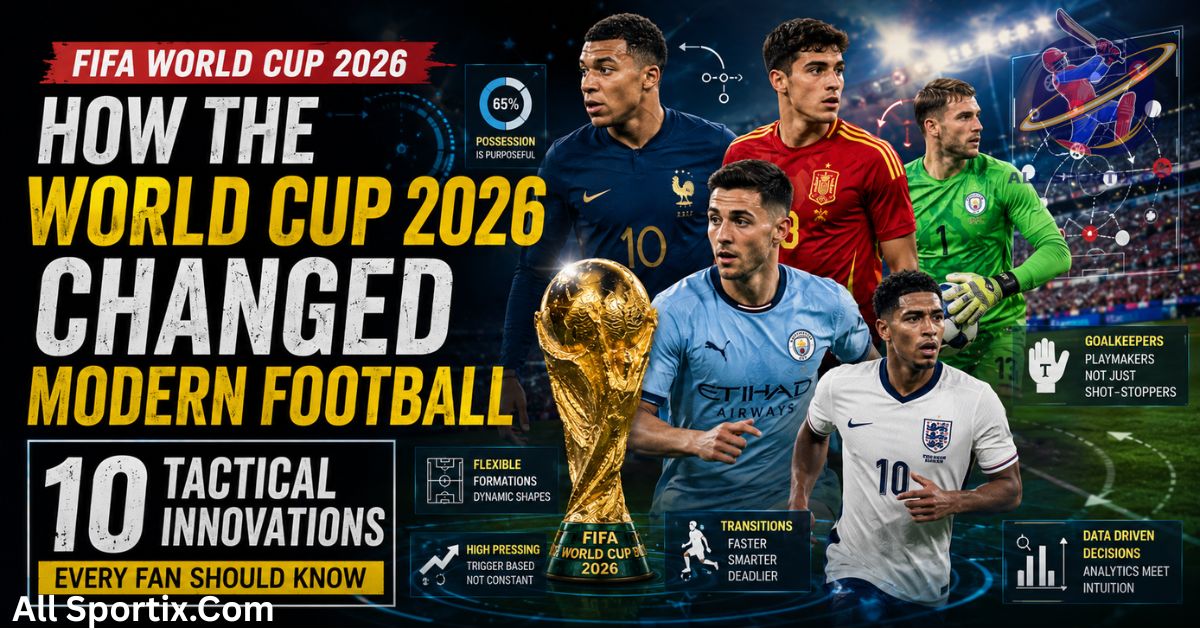
How fifa world cup 2026 changed modern football? The FIFA World Cup 2026 did more than crown a champion it rewrote the tactical rulebook of modern football. Across 104 matches and three host nations, a global audience watched the sport evolve in real time.
From goalkeepers acting like quarterbacks to substitutes deciding knockout games, the FIFA World Cup 2026 tactical innovations on display were unlike anything seen at previous tournaments. If you want to understand where football is heading, this is the tournament to study.
Why FIFA World Cup 2026 Was a Turning Point for Modern Football
Every World Cup reflects the era it’s played in. But the 2026 edition was different. The expanded 48-team format, new hydration break rules, and five-second timers on dead balls created a fundamentally altered competitive environment and coaches who recognised that early thrived.
FIFA World Cup 2026 tactical evolution was not just reflected in how quickly teams move the ball, but also in how aggressively they attack space without it. That shift from possession as an end to possession as a weapon defined the tournament’s DNA.
How fifa world cup 2026 changed modern football? The 48-Team Format Forced Tactical Evolution
Let’s start with the structure, because everything else flows from it.
The 2026 FIFA World Cup featured 48 teams competing in 104 matches across the United States, Canada, and Mexico a massive expansion from the 32-team format used since 1998. Groups of three teams with the top two advancing created different tactical dynamics, meaning every match mattered more.
More matches also meant more fatigue. Teams that relied on a fixed tactical identity press hard, press always ran out of steam by the knockout rounds. The sides that adapted survived.
The 48-team format, extreme climate variation, and compressed recovery windows created a different tactical environment one where modern football tactics trends collided with tournament realities.
10 Tactical Innovations That Defined FIFA World Cup 2026
1. The Death of Constant High Pressing
Pressing is no longer a style it’s a tool. Teams at this tournament pressed in calculated bursts, not relentlessly.
The high press proved a group stage luxury. No squad can sustain pressing intensity across seven matches in summer heat. The teams that survived pressed in calculated bursts, not constantly.
Spain, Argentina, and the USA were the tournament’s best examples each team pressed high only in specific triggers: after losing the ball in the final third or when opponents played slow build-up. They conserved energy intelligently, then turned the intensity on when it mattered.
2. How fifa world cup 2026 changed modern football ?Counter-Pressing as a Tactical Weapon
Where non-stop pressing faded, counter-pressing immediately winning the ball back after losing it flourished.
FIFA’s Technical Study Group identified the rise of aggressive counter-pressing as one of three defining trends reshaping the modern game, with successful sides regaining the ball faster than in any previous World Cup.
Former Manchester City defender Pablo Zabaleta, a TSG panel member, described how the best teams made this part of their identity reacting quickly instead of dropping back into a low block, winning the ball in the opposition half to counter-attack closer to the box.
3. Goalkeepers Became Playmakers
This was arguably the most visually striking innovation of the 2026 World Cup.
Just 52% of goal kicks were taken by goalkeepers during the group stage, compared to 91% at FIFA World Cup 2022. Instead, teams increasingly chose centre-backs to initiate build-up, giving goalkeepers more time to assess the opposition’s pressing approach before getting involved.
Former Switzerland goalkeeper Pascal Zuberbühler, who heads the TSG’s technical operations, described the modern goalkeeper as “almost like a quarterback,” responsible not merely for preventing goals but also dictating the first phase of possession.
Cape Verde’s Vozinha became the tournament’s unlikely symbol of this trend composure in possession, not just shot-stopping bravado. Argentina vs Spain 2026 World Cup Final Preview/Report
4. Substitutes Changed Games, Not Just Minutes
The “super sub” was no longer a romantic football story. In 2026, it became cold tactical reality.
Substitutes contributed 43 goals during the group stage an unusually high figure that reflected how managers were treating their squads as bigger player units rather than relying solely on their starting lineup.
Germany’s Deniz Undav was the standout example, contributing three goals and two assists from the bench. For coaches, this redefined squad selection: rotation in 2026 was not about managing fatigue it was about deploying different tactical functions at different moments.
5. The Hydration Break Became a Tactical Timeout
FIFA’s new mandatory three-minute hydration break, introduced at the 22nd minute of each half, looked like a practical health measure. Smart coaches turned it into something more.
FIFA introduced mandatory 3-minute hydration breaks at the 22nd minute of each half unlike previous cooling breaks that were weather-dependent, these happened in every match regardless of conditions.
With four natural stoppages now built into every match two breaks plus halftime plus full time the time between a manager’s messages to their players was cut in half, while the number of in-game team talks effectively tripled. Teams that had better tactical messaging in these windows had a clear edge.
6. Dead Ball Rules Killed Time-Wasting And Changed Rhythm
A five-second countdown was introduced to deter time-wasting during goal-kicks, and it reduced the average time taken for a goal-kick to 23.8 seconds in 2026 from 27.7 seconds in 2022 the lowest figure at any tournament since 2010.
The average time taken for a throw-in also decreased to 13.3 seconds, down from 15.7 seconds in Qatar a 15.5% reduction meaning the average game saw throw-in time cut by 2 minutes and 45 seconds compared to 2022.
Faster restarts meant more transitions per game. Defensive structures had less time to reset. This is why teams with quick vertical passing out of dead-ball situations like Spain and Argentina consistently looked sharper.
7. Inverted Fullbacks Became Non-Negotiable
No longer an experiment; now a baseline requirement.
Inverted fullbacks became a baseline requirement at the 2026 World Cup. Rather than hugging the touchline, fullbacks like Trent Alexander-Arnold and João Cancelo drifted centrally during possession phases to create numerical superiority in midfield.
This tactical shift changes everything about how teams press. If your fullbacks play narrow, the opponent’s wide forwards must track them infield freeing your wide attackers to stretch defences. Teams that didn’t adapt to this lost midfield duels consistently.
8. Set Pieces as a Primary Weapon
In knockout football, creativity fades and legs tire. Dead-ball situations became decisive.
Set pieces will decide knockout games. When creativity fails and legs go in the second week, dead ball situations become primary weapons. The data from 2022 made this undeniable.
The 2026 tournament underlined it. Teams with specialist set-piece coaches, detailed pre-match preparation, and runners willing to attack delivery zones consistently threatened and scored in the closing stages of tight games.
9. Formation Fluidity Over Fixed Systems
The decisive teams at World Cup 2026 were those that could switch between possession control, compact defending, and fast transition attacks without losing structure.
Argentina shifted between a 4-4-2 mid-block and a 3-4-3 pressing shape within a single match. Spain morphed their 4-3-3 into a 2-3-5 in possession. England’s struggles partly stemmed from being too reliant on one shape. Argentina vs England 2026 Semi-Final Match Report
The lesson is stark: formations are no longer fixed systems they are starting positions.
10. Squad Depth as a Tactical Asset
This tournament exposed every team that carried passengers in their 26-man squad.
Your squad of 23 is a tactical instrument, not a backup plan. With eight matches to reach the final rather than the traditional six, depth wasn’t just useful it was essential. Spain’s ability to rotate between their first and second choices without any drop in quality was arguably the clearest tactical advantage of the final few.
How Fifa world cup 2026 changed modern football ? Key Statistics
| Tactical Trend | 2022 (Qatar) | 2026 (USA/Canada/Mexico) |
|---|---|---|
| Goalkeeper goal-kicks taken | 91% | 52% |
| Substitute goals (group stage) | Lower than 2026 | 43 goals |
| Average goal-kick time | 27.7 seconds | 23.8 seconds |
| Average throw-in time | 15.7 seconds | 13.3 seconds |
| Injury-time goal share | Lower than 2026 | 11.4% of all goals |
| Teams in tournament | 32 | 48 |
| Total matches | 64 | 104 |
Source: FIFA Technical Study Group, Opta Analyst (verify latest figures before publication)
What These Tactical Innovations Mean for Football’s Future
The FIFA World Cup 2026 tactical innovations won’t stay on the international stage. They trickle down from national teams to elite clubs, to youth academies, to Sunday league coaches asking why their goalkeeper insists on booting every goal kick upfield.
What the 2026 World Cup proved is that tactical intelligence now outweighs physical dominance. A team with six elite outfielders and a smart bench will consistently outperform a team of eleven all-stars playing a rigid system. FIFA World Cup 2026 Top Scorers and Golden Boot Race
The tournament demonstrated that possession alone is no longer the primary measure of attacking intent. Instead, faster ball circulation has become a mechanism for creating transition opportunities, not prolonging control.
The coaches who understood that and built squads flexible enough to execute it were the ones still competing in Atlanta and New Jersey in the tournament’s final week.
Frequently Asked Questions
What were the biggest tactical innovations at FIFA World Cup 2026?
The three biggest tactical innovations identified by FIFA’s Technical Study Group were the rise of substitute impact (43 group stage goals from the bench), aggressive counter-pressing replacing constant high pressing, and the evolution of goalkeepers into build-up playmakers. These three shifts defined the 2026 tournament.
How did the 48-team format change tactics at World Cup 2026?
The expanded format meant teams needed to play up to eight matches to win the tournament instead of six. This made squad depth and tactical flexibility more important than ever, as relying on a single system across a longer tournament proved unsustainable.
Why did goalkeepers stop taking their own goal-kicks at World Cup 2026?
Teams discovered it was tactically smarter to have centre-backs restart play, allowing goalkeepers more time to read the press before receiving the ball as an extra outfield player. FIFA data showed the share of goalkeeper-taken goal-kicks dropped from 91% in 2022 to just 52% in 2026.
What role did substitutes play at FIFA World Cup 2026?
Substitutes scored 43 goals in the group stage alone an unusually high figure. Coaches treated their benches as tactical instruments, deploying different player types (speed merchants, presser, set-piece specialists) at specific match moments rather than simply managing fatigue.
Did the new hydration break rule affect tactics at World Cup 2026?
Yes. The mandatory three-minute break at the 22nd minute of each half effectively gave coaches three additional in-game team talks per match. Tactically sharp coaching staffs used these windows to reset structures, issue pressing triggers, and make early in-game adjustments.
What is rest defense and why was it important at World Cup 2026?
Rest defense refers to the off-ball positioning of players during attacking phases essentially, how teams defend before they lose possession. At the 2026 tournament, teams with poor rest defense were brutally exposed on fast counter-attacks, while disciplined sides like Spain minimised transition goals by maintaining defensive shape even when attacking.
How did the five-second rule change FIFA World Cup 2026 football?
A five-second countdown for goal-kicks and throw-ins reduced dead-ball time significantly by nearly three minutes per match compared to 2022. This created more continuous play, more transitions per game, and rewarded teams with quick, vertical passing out of dead-ball situations.
Conclusion
How fifa world cup 2026 changed modern football? The FIFA World Cup 2026 changed modern football in ways that will influence tactics at every level of the game for years to come. From the goalkeeper acting as a quarterback to the substitute becoming the most important tactical decision a manager makes, the tournament demanded intelligence over brute force, adaptability over identity, and squad thinking over individual brilliance.
This wasn’t just a bigger World Cup. It was a smarter one. The 10 tactical innovations explored here aren’t trends to admire and forget they’re the new blueprint for how football is played.
And the coaches who ignore them risk being the next Thomas Tuchel: brilliant in theory, obsolete in the final minutes.